

Last Updated: November 2, 2026
Quick Summary
To get rid of green algae in a pool, brush and vacuum every surface first, then shock with unstabilized chlorine and hold free chlorine at shock level until the water clears. Run the pump 24 hours a day and clean the filter as pressure climbs; a green pool usually clears in 3 to 7 days.
- Test free chlorine, pH, cyanuric acid and calcium hardness before adding any chemicals.
- Brush walls, floor, steps and ladder rungs before shocking, since chlorine can't kill algae stuck to surfaces.
- Re-dose shock morning and evening until free chlorine holds overnight with less than 1 ppm loss.
- Backwash sand and DE filters when pressure reads 8-10 psi above the clean starting pressure.
- If chlorine holds overnight but water stays cloudy, the problem is filtration, not live algae.
Table of Contents
- How to Get Rid of Green Algae in a Pool: The Full Process
- What You'll Need Before You Start
- Pool Water Testing for Algae Treatment
- Step 1: Brush and Vacuum the Pool Walls, Floor and Steps
- How to Shock a Pool for Algae
- How Long Does It Take to Clear a Green Pool?
- Filter Care and Troubleshooting Cloudy Water After Treatment
- How to Prevent Algae in a Pool
- Choosing the Right Algaecide and Shock for Your Pool
- Frequently Asked Questions
How to Get Rid of Green Algae in a Pool: The Full Process
Green pool water is algae, and you can clear it.
Green algae is a single-celled plant that blooms in pool water when chlorine drops and circulation slows. It turns water cloudy, then green, then coats walls in slippery layers.
A common mistake is pouring in shock and calling it done. Algae hides in the plaster, ladder rungs, and behind the skimmer.
- Test first, treat second
- Brush before you shock
- Run the pump the whole time
What You'll Need Before You Start
Gather everything before you touch the water. A mid-treatment run to the store costs you a day, and algae doubles while you're gone.
You'll need:
- A pool water test kit for chlorine and pH
- A pool brush with a long pole
- A pool vacuum or manual vacuum head
Check your filter pressure before you start. Note the reading. You'll want it later.
Watch out: never mix chemicals together in one bucket. Add each product to the pool separately, and follow the label rates.
Pool Water Testing for Algae Treatment
Pool water testing for algae treatment means checking free chlorine, pH, stabilizer, and calcium hardness before you add anything.
Here's what to check and why:
| Reading | Target Range | Why It Matters |
|---|---|---|
| Free chlorine | 1-3 ppm | Too low lets algae grow |
| pH | 7.2-7.6 | High pH weakens chlorine |
| Cyanuric acid | 30-50 ppm | Too much locks chlorine up |
| Calcium hardness | 200-400 ppm | Low levels damage surfaces |
Cyanuric acid is the one most people miss. It shields chlorine from sunlight, but when it climbs too high, chlorine stops working no matter how much you add.
Get the order right when balancing. Our guide on how to balance pool water chemistry in the right order walks through the sequence so your chemicals work together.
Step 1: Brush and Vacuum the Pool Walls, Floor and Steps
Brushing comes first because algae clings to surfaces. Chlorine in the water can't kill what's stuck to the wall.
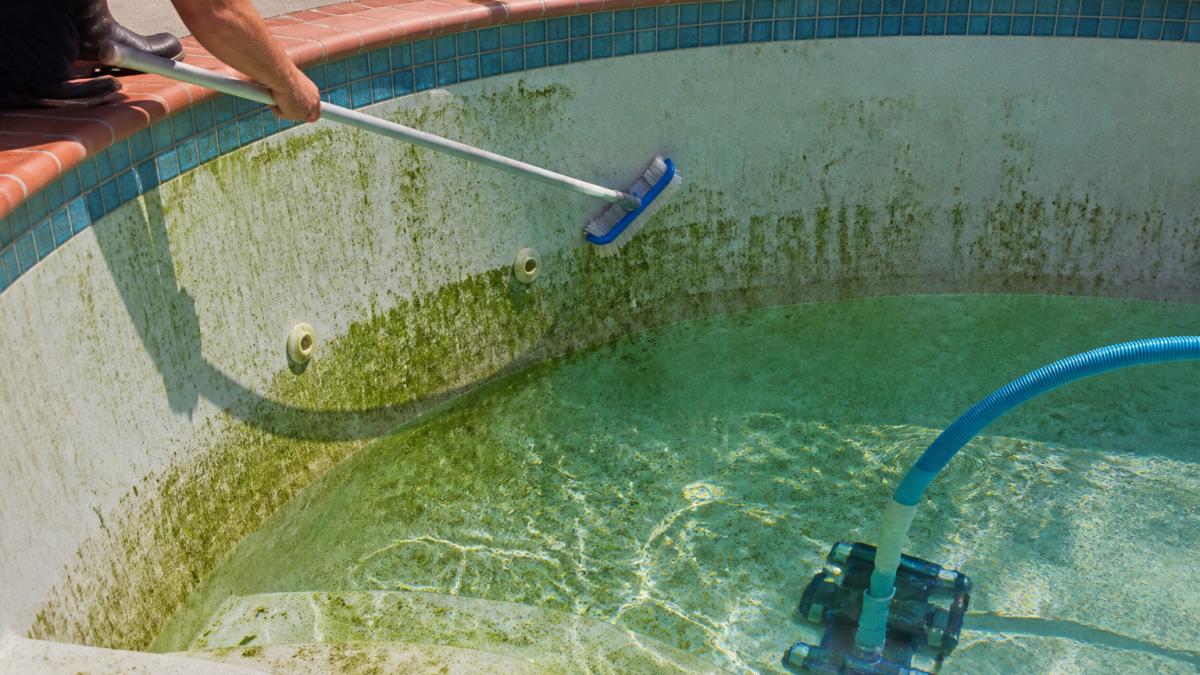
Use a stiff brush that suits your surface. Vinyl liners need a softer brush than plaster.
Then skim and vacuum:
- Skim floating debris and algae piles with a net
- Vacuum settled algae from the floor
- Vacuum to waste if your filter has that setting, so algae doesn't just cycle back
Expect the water to look worse before it looks better. You're lifting algae into the water so the filter and chlorine can deal with it.
How to Shock a Pool for Algae
To shock a pool for algae, you raise free chlorine well above the normal 1-3 ppm range and hold it there until the water clears and chlorine demand drops. Chlorine targets for a green pool are typically set well above the normal range, with the exact level depending on how heavy the bloom is and re-dosing whenever the reading falls below target. The exact number depends on your cyanuric acid level, because stabilizer buffers chlorine and reduces its killing power. Because stabilizer levels shape how quickly chlorine can clear an algae bloom, keep testing as you brush and filter the pool, then address any lingering haze with steps to fix cloudy pool water.
Calculate your dose from pool volume
Shock products are dosed by weight or volume per 10,000 litres of water, and the label rate assumes a specific concentration of available chlorine. To dose correctly:
- Calculate pool volume in litres. Rectangular: length (m) × width (m) × average depth (m) × 1,000. Round: diameter (m) × diameter (m) × average depth (m) × 0.785 × 1,000.
- Read the shock label for the dose rate per 10,000 litres and the available chlorine percentage.
- Scale the dose to your volume; for a green pool, use the high end of the label range.
- Calcium hypochlorite (typically 65-73% available chlorine): about 150-200 g per 10,000 litres to reach roughly 10 ppm free chlorine. Sodium hypochlorite liquid (typically 10-12%): about 1 litre per 10,000 litres. Always confirm against the label, since concentrations vary by brand.
- If stabilizer is above 50 ppm, increase the target free chlorine proportionally, a common rule is to hold free chlorine at about 7.5% of the cyanuric acid reading (for example, 15 ppm free chlorine at 200 ppm stabilizer) until the bloom clears.
Hold the shock level, don't just add once
A single dose rarely finishes a green pool. Algae and organic debris consume chlorine quickly, so free chlorine can fall back near zero within hours. Test morning and evening and re-dose to your target until:
- The water is clear or only slightly cloudy.
- Combined chlorine (chloramines) reads 0.5 ppm or lower.
- Free chlorine holds overnight with less than 1 ppm loss.
That overnight hold test is the clearest signal the bloom is dead and you can let chlorine drift back to the normal 1-3 ppm range.
Product choice matters
Use an unstabilized shock, calcium hypochlorite or sodium hypochlorite, so you don't push cyanuric acid higher.
Watch out: never mix shock with algaecide or other chemicals in the same container, and never add water to chemicals, add chemicals to water.
PoolBoss X-tra Strength Algaecide 1L →
The PoolBoss Pool Shock 6kg is an unstabilized chlorinating granule that quickly eliminates bacteria, algae, and organic contaminants from pool water.

How Long Does It Take to Clear a Green Pool?
A green pool usually clears in 3 to 7 days with proper shocking and continuous filtration. Light green water can clear in a couple of days; dark, murky water with heavy algae buildup can take a week or more.
What speeds it up:
- Running the pump 24 hours a day
- Brushing daily
- Cleaning the filter when pressure climbs
What slows it down:
- High stabilizer levels
- A dirty or undersized filter
- Short pump run times
Cloudy water after treatment is a good sign. Dead algae is what's clouding it. Keep filtering and it will clear.
Filter Care and Troubleshooting Cloudy Water After Treatment
Your filter does the heavy lifting once the algae is dead. Dead algae becomes fine debris that clouds the water, and only the filter removes it. Getting the cleaning method wrong is a common reason cloudy water lingers for a week.
Sand filters
Backwash when the pressure gauge reads 8-10 psi (about 0.5-0.7 bar) above your clean starting pressure, or when flow visibly drops. After backwashing, run a rinse cycle for 15-30 seconds before returning to filter mode so you don't send debris back into the pool. During an active algae treatment, expect to backwash every 1-2 days. If pressure climbs quickly after each backwash, the sand may be channeled or gummed up; a sand change or filter cleaner soak may be needed.
Diatomaceous earth (DE) filters
Backwash the same way, when pressure rises 8-10 psi above the clean reading, then recharge with fresh DE per the label (typically about 1 kg per 10 square feet of filter area, but confirm on your filter). DE filters capture the finest dead algae particles, so they often clear cloudy water fastest, but they also load up fastest. Expect to backwash and recharge every 1-2 days during treatment.
Cartridge filters
Cartridges can't be backwashed. Pull the cartridge when pressure rises 8-10 psi above clean, hose it down from the top down, and inspect the pleats for embedded algae. During a green pool cleanup, plan to clean the cartridge every 1-2 days and do a soak in a cartridge cleaner at the end of treatment. Keep a spare cartridge on hand so the pump can keep running while one is being cleaned, stopping circulation mid-treatment slows the whole process.
When to repeat the process
If the water stays cloudy after several days:
- Check that free chlorine is still holding at shock level; if it has dropped, re-dose before blaming the filter.
- Clean or backwash the filter again, even if pressure hasn't risen much, dead algae can blind a cartridge without a big pressure change.
- Confirm the pump is running 24 hours a day until the water clears.
A useful decision rule: if chlorine holds overnight but water stays cloudy, the problem is filtration, clean or service the filter. If chlorine won't hold overnight, the problem is still live algae or organic load, re-dose and keep brushing. If algae returns within days of clearing, the cause is usually low chlorine or poor circulation, not a weak product. Fix water balance and run time before buying another bottle.
How to Prevent Algae in a Pool
Prevention comes down to three habits: keep chlorine steady, run the pump long enough, and brush on a schedule. Algae needs still water and low chlorine to bloom. Take both away.
- Test free chlorine 2 to 3 times a week in warm weather
- Keep pH in range so chlorine stays effective
- Run the pump at least 8 hours a day, longer in heat
A weekly algaecide dose is cheap insurance. It won't fix a green pool on its own, but it makes blooms far less likely.
Choosing the Right Algaecide and Shock for Your Pool
Match the product to the job. Shock kills the bloom. Algaecide prevents the next one and helps clear what's left. You usually want both.
For a green pool, start with shock to knock the bloom down, then add an algaecide to stop it returning. For maintenance, a lower-dose algaecide weekly is enough.
Product options:
- PoolBoss X-tra Strength Algaecide 1L controls green, black, and mustard algae and suits all pool surfaces
- PoolBoss Algicide Supreme 50% 1L is the concentrated option for stubborn or repeat blooms
- PoolBoss Formula 6000 1L is a non-foaming algaecide that reduces chlorine demand
Best for: green pools that need a fast knock-down, use shock plus an algaecide. Skip if: your stabilizer is already high, since more chlorine won't help until you dilute.


Frequently Asked Questions
Can you swim in a pool with green algae?
No. Green algae itself is not usually toxic, but it signals that sanitizer levels have dropped and bacteria may be present. Swimming in cloudy green water also makes it hard to see the pool floor, which raises the risk of slips and injuries. Keep everyone out until free chlorine holds at 1-3 ppm, the water is clear, and pH sits between 7.2 and 7.8. Test the water before reopening and run the pump continuously while you treat.
What chemicals do you need to kill green pool algae?
You need a chlorine shock, a liquid algaecide, and a test kit. PoolBoss Pool Shock 6kg ($89.99) is an unstabilized granule that kills algae and organic contaminants. Pair it with an algaecide such as PoolBoss X-tra Strength Algaecide 1L ($11.99), which controls green, black and mustard algae, or PoolBoss Formula 6000 1L ($39.99) if you want a non-foaming formula that also reduces chlorine demand. Test first so you know your starting chlorine, pH and stabilizer readings.
Should you brush a pool before or after shocking it?
Brush before you shock. Algae forms a protective layer over pool walls, floors and steps, and chlorine cannot penetrate it easily. Scrubbing breaks that layer up and lifts algae into the water where the shock can kill it. Brush the walls, floor, steps and any corners or ladders, then vacuum settled algae to waste if your filter allows. Add the shock after brushing so the chlorine works on exposed algae rather than a film.
How often should you run the pool pump when treating algae?
Run it 24 hours a day until the water clears, then return to your normal schedule of 8 to 12 hours daily. Continuous filtration is what removes dead algae and keeps chlorine circulating. Check the filter pressure every few hours, since dead algae loads the filter quickly. Backwash or clean the filter when pressure rises about 8 to 10 psi above the clean starting point, and keep skimming debris off the surface so it does not recontaminate the water.
Green water is a solvable problem, but it rewards patience and the right order of steps. At Poolside Supply, we help pool owners across the region clear green water every season with products like our PoolBoss shock and algaecides, backed by a satisfaction guarantee and a price match guarantee. If you'd rather have someone walk you through it, our team will map the process to your pool. Get started with Poolside Supply and get your water clear again.
