

Last Updated: October 31, 2026
Quick Summary
Balance pool water chemistry in this order: total alkalinity first, then pH, then calcium hardness, then sanitizer and stabilizer last. Fixing alkalinity before pH stops pH bounce, and you should retest after a full circulation cycle before the next step.
- Target ranges are pH 7.4 to 7.6, total alkalinity 80 to 120 ppm, and calcium hardness 200 to 400 ppm.
- Test pool water two to three times per week during swim season and daily during heat waves or heavy bather load.
- Wait four to six hours, a full circulation cycle, before retesting after dosing to avoid over-dosing.
- Add chemicals to water, never water to chemicals, and never mix two chemicals together before adding them.
- Adding pH Down and an alkalinity increaser at the same time can cancel each other out.
Table of Contents
- Why Pool Water Chemistry Balance Comes Before Anything Else
- Pool Water Testing: How to Read Your Results Accurately
- Your Pool Water Chemistry Chart: Every Target Range in One Place
- Pool Chemical Adjustment Order: The Sequence That Prevents pH Bounce
- How Often to Test Pool Water and When to Retest After Dosing
- Handling Chemicals Safely and Troubleshooting Conflicting Readings
- Frequently Asked Questions
Why Pool Water Chemistry Balance Comes Before Anything Else
Balanced water protects swimmers, pool surfaces, and equipment. That is the core of pool water chemistry: keeping pH, alkalinity, calcium, and sanitizer inside their target ranges so every chemical you add works the way it should. Owners who skip balancing often end up fighting cloudy water, scale, and chlorine that seems to do nothing. The fix is order, not more product. This guide shows you how to balance pool water chemistry step by step, in the sequence that prevents pH bounce.
Pool Water Testing: How to Read Your Results Accurately
Test results tell you what to adjust and how much. Read them in the right order and the rest of the job gets simple.
- pH first. This number decides how well your sanitizer works and how your other chemicals behave.
- Total alkalinity second. It acts as a buffer that holds pH steady.
- Calcium hardness third. Low hardness pulls minerals from your surfaces. High hardness leaves scale.
- Sanitizer and stabilizer last. Chlorine level and cyanuric acid tell you whether your water is protected from sunlight and bacteria.
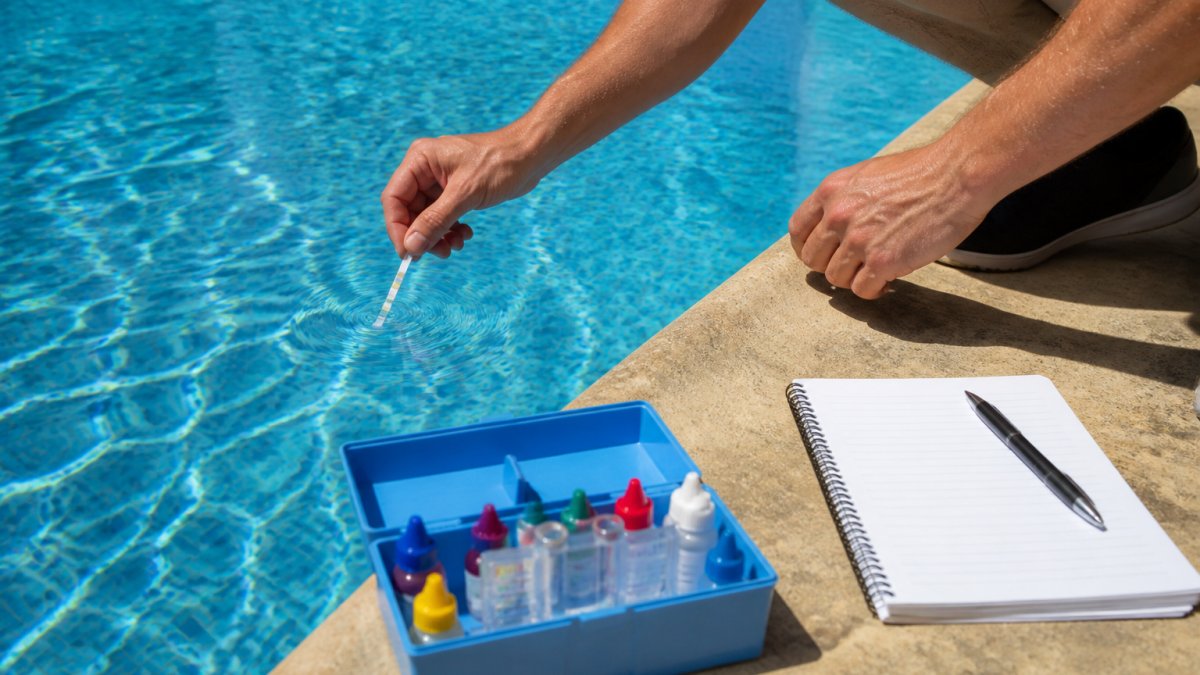
Test Strip vs Liquid Kit: What Each One Misses
Test strips are fast and easy to read. They give you a workable picture of pH, chlorine, and alkalinity in seconds. What they miss is precision. Strips can drift on calcium hardness and cyanuric acid, and they degrade if left in a hot shed. Liquid kits take longer but give tighter readings, especially for alkalinity and hardness. Keep strips for quick daily checks and use a liquid kit when a number looks off or you are dosing a big adjustment.
Your Pool Water Chemistry Chart: Every Target Range in One Place
Use these ranges as your reference point. They apply to most residential pools.
| Measurement | Target Range | What It Controls |
|---|---|---|
| pH | 7.4 to 7.6 | Swimmer comfort, sanitizer strength |
| Total alkalinity | 80 to 120 ppm | pH stability |
| Calcium hardness | 200 to 400 ppm | Surface and equipment protection |
| Free chlorine | 1 to 3 ppm | Bacteria and algae control |
| Cyanuric acid | 30 to 50 ppm | Sunlight protection for chlorine |
Keep this pool water chemistry chart near your test kit. When a reading sits outside its range, you know exactly which product to reach for. You can browse pH and water balance chemicals to match each target range.
Pool Chemical Adjustment Order: The Sequence That Prevents pH Bounce
Adjust in a fixed order every time: alkalinity, then pH, then calcium hardness, then sanitizer. This pool chemical adjustment order is the step most owners skip, and it is why their pH swings back within a day. Fix alkalinity first and pH holds. Fix pH first and alkalinity drags it right back out of range.
- Raise total alkalinity if it reads low. Use an alkalinity increaser such as PoolBoss Alka-Plus 2kg and let it circulate before retesting.
- Adjust pH. If pH is high, add a pH reducer such as PoolBoss pH Down 3kg, a sodium bisulphate formula that lowers pH and helps your sanitizer work better.
- Raise calcium hardness if it is low, using PoolBoss Cal-Plus 2kg to protect surfaces and equipment from soft water.
- Add sanitizer and stabilizer last, once the water is balanced.
Step-by-Step Dosing Example for a 20,000 Litre Pool
Raise alkalinity toward 100 ppm first. Retest after a full circulation cycle. Then lower pH from 7.9 toward 7.5 with pH Down, following the label dose for your volume. Retest. Finally, raise calcium toward 250 ppm with Cal-Plus. Add sanitizer only after each step settles. Dose in small amounts and retest between steps rather than dumping everything in at once.


How Often to Test Pool Water and When to Retest After Dosing
Testing frequency is not a fixed rule; it depends on use, weather, and what you just added. The general guidance is two to three times per week during swim season, daily during heat waves or heavy bather load, and after any chemical addition once the pool has circulated. But the more important skill is knowing when a reading is trustworthy and when to verify it with a different method.
Test strip vs liquid kit vs professional testing. Test strips are fast and give a workable picture of pH, chlorine, and alkalinity, but they are less precise for calcium hardness and cyanuric acid, and they degrade if stored in heat or humidity. Liquid kits (such as those using DPD for chlorine and phenol red for pH) take longer but give tighter readings, especially for alkalinity and hardness.
Sampling technique matters. Take your sample from elbow depth, away from return jets and skimmer openings, and not from the surface where oils and debris collect. Rinse the test container with pool water before filling. For strips, dip and remove immediately, do not shake off excess water, and read within the time window on the label. For liquid kits, follow the drop count and color comparison exactly; guessing at color is a common source of false readings.
When to retest after dosing. After adding any chemical, wait for a full circulation cycle before retesting. For most residential pools, that is four to six hours, but it can be longer in cold water or with a variable-speed pump running at low rpm. Retesting too soon gives a false reading and tempts you to over-dose. If you add alkalinity increaser, retest alkalinity and pH after circulation; if you add pH Down, retest pH and alkalinity, because pH adjustment can shift alkalinity slightly. After adding chlorine, retest free chlorine within a few hours to confirm the dose held.
Troubleshooting conflicting readings. If pH and alkalinity disagree with what you expect, clean your test equipment and retest before dosing. A common case is pH that rebounds after adjustment; this usually means alkalinity is still low or the pool has high aeration from a waterfall or spillover. Another case is alkalinity that will not move; check that the product is fresh and that you are using the correct dose for your volume. If a reading still looks wrong after a clean retest, bring a sample to a professional for verification rather than adding more chemicals.
Record each result with the date and any chemical additions. Trends matter more than single readings: alkalinity creeping down week after week tells you to check your fill water, while pH rising steadily points to aeration or high alkalinity. That record is what turns testing from a chore into a diagnostic tool.
Handling Chemicals Safely and Troubleshooting Conflicting Readings
Add chemicals to water, never water to chemicals. Wear gloves and eye protection, keep products dry and sealed, and never mix two chemicals together before adding them. Store everything out of reach of children and pets (Use household chemicals safely).
Watch out: adding pH Down and an alkalinity increaser at the same time can cancel each other out, so always finish one step and retest before starting the next.
Conflicting readings usually mean a testing problem, not a chemistry one. If pH and alkalinity disagree with what you expect, clean your test equipment and retest before dosing.
Frequently Asked Questions
What order should you balance pool chemicals in?
Start with total alkalinity, then adjust pH, then calcium hardness, and finish with sanitizer and stabilizer. Alkalinity acts as a buffer, so fixing it first stops pH from bouncing back after you adjust it. Test again after each step and wait the recommended time before adding the next chemical. Adding everything at once can cause cloudiness and makes it impossible to tell which product worked.
How often should you test pool water?
Test pH and chlorine two to three times a week during heavy swimming season, and run a full panel for alkalinity, calcium hardness and cyanuric acid once a week. After heavy rain, a large top-up with fresh water, or a big swimmer load, retest within 24 hours. Retest 24 to 48 hours after any chemical adjustment before dosing again, so you are working from current numbers rather than guesses.
Can you add multiple pool chemicals at the same time?
No. Add one product at a time, pre-dissolve dry chemicals in a bucket of pool water where the label says to, and wait at least 30 minutes to several hours before the next addition. Never mix chlorine and acid together, even in the same bucket, because the reaction releases dangerous gas. Follow the pool chemical adjustment order and let circulation run between steps.
Is 5 ppm too high for chlorine in a pool?
It depends on your cyanuric acid level. With stabilizer around 30 to 50 ppm, a free chlorine reading of 5 ppm is at the upper end of normal and generally fine for swimming. With no stabilizer, 5 ppm is high and will fade quickly in sunlight. Check combined chlorine too: above 0.5 ppm means you need to shock rather than just wait it out.
Balancing pool water chemistry is a sequence, not a shopping list. Follow the order, dose in small steps, and retest before you add more. Poolside Supply carries the PoolBoss line of pH, alkalinity, calcium, and stabilizer products, backed by our Price Match Guarantee and Satisfaction Guarantee, plus real advice from a team that balances water every day. Get started with Poolside Supply and keep your water clean, safe, and clear all season.
