

Quick Summary
For most green algae blooms, the best pool shock for algae is an unstabilized chlorinating shock dosed at the label's algae treatment rate after the water is balanced. Raise free chlorine to around 10 ppm when cyanuric acid is 30-50 ppm, brush every surface, and hold that level until chlorine holds overnight.
- PoolBoss Pool Shock 6 kg costs $89.99 and is unstabilized cal-hypo for active green algae on plaster pools.
- CAPO Vinyl-Shock 6 kg at $89.99 is chlorine-free and safe for vinyl liner pools.
- Adjust pH to roughly 7.2 to 7.6 before shocking so chlorine keeps its killing power.
- Backwash or clean the filter when pressure rises 8-10 psi above the clean baseline.
- If cyanuric acid is already high, dilute the water through a partial drain and refill.
Table of Contents
- Comparing Pool Shock Options for Algae
- How to Shock a Pool With Algae
- The Best Pool Shock for Green Algae
- How Long Does Pool Shock Take to Kill Algae?
- Why Is Pool Shock Not Killing Algae?
- Choosing Shock Based on Pool Chemistry and Surface
- Picking the Right Shock at Poolside Supply
- Frequently Asked Questions
Comparing Pool Shock Options for Algae
Last Updated: November 1, 2026
Green water rarely waits for a convenient moment. Pool owners often want a pool shock for algae that actually works, not another bucket of granules that fizzles out. The short answer: pool shock for algae means an unstabilized chlorinating shock applied at the right dose, after the water is balanced, clears most green algae blooms. The harder part is matching the product to your pool's surface and chemistry, and knowing when shock alone won't finish the job.
| Product | Price | Type | Active Ingredient | Best For |
|---|---|---|---|---|
| PoolBoss Pool Shock 6 kg | $89.99 | Unstabilized chlorinating granules | Calcium hypochlorite | Active green algae, routine shocking |
| PoolBoss Insta-Boost Shock 6 kg | $114.99 | Fast-acting shock | Calcium hypochlorite (fast-dissolve) | Cloudy water, post-storm resets |
| CAPO Vinyl-Shock 6 kg | $89.99 | Chlorine-free multi-action | Non-chlorine oxidizer blend | Vinyl liner pools |
| PoolBoss Concentrate Granular 6 kg | $84.99 | Concentrated sanitizer | Stabilized chlorine | Weekly maintenance and prevention |
How We Compared These Products
- Usable chlorine strength per dose. Calcium hypochlorite granules are typically around 65-73% available chlorine, while stabilized dichlor products are closer to 56-62% and add cyanuric acid with every dose. A bucket that costs less per kilogram can deliver less killing power per treatment if its available chlorine is lower.
- Cost per treatment, not per bucket. Divide the package price by the number of algae-treatment doses the label supports for a given water volume.
- Chemistry side effects. Cal-hypo raises calcium hardness over time; stabilized shock raises cyanuric acid. In a pool that already tests high for either, the 'cheaper' product can create a bigger correction bill later.
- Surface compatibility. Vinyl liners tolerate gentler, chlorine-free oxidation better than repeated high-dose cal-hypo, while plaster and concrete handle aggressive chlorination without the same risk.
The key distinction is between shock that kills an active bloom and sanitizer that keeps algae from returning. Failed algae treatments often come from confusing the two. If you want the background on ordering your adjustments correctly, our guide on how to balance pool water chemistry in the right order covers the sequence in detail.
Matching the Product to Your Situation
- Active green bloom, plaster or concrete pool, normal stabilizer: PoolBoss Pool Shock (6 kg) at $89.99 is the workhorse, unstabilized cal-hypo that raises free chlorine fast without adding cyanuric acid.
- Cloudy water after a storm or heavy use, need a fast reset: PoolBoss Insta-Boost Shock (6 kg) at $114.99 dissolves quickly and is built for a single strong application.
- Vinyl liner, sensitive to harsh dosing: CAPO Vinyl-Shock (6 kg) at $89.99 is chlorine-free and multi-action, reducing the risk of liner damage from repeated high chlorine levels.
If your stabilizer level is already high, none of the stabilized options will fix an active bloom until you dilute the water through a partial drain and refill. That is a chemistry problem, not a product problem, and no shock label overcomes it.
How to Shock a Pool With Algae
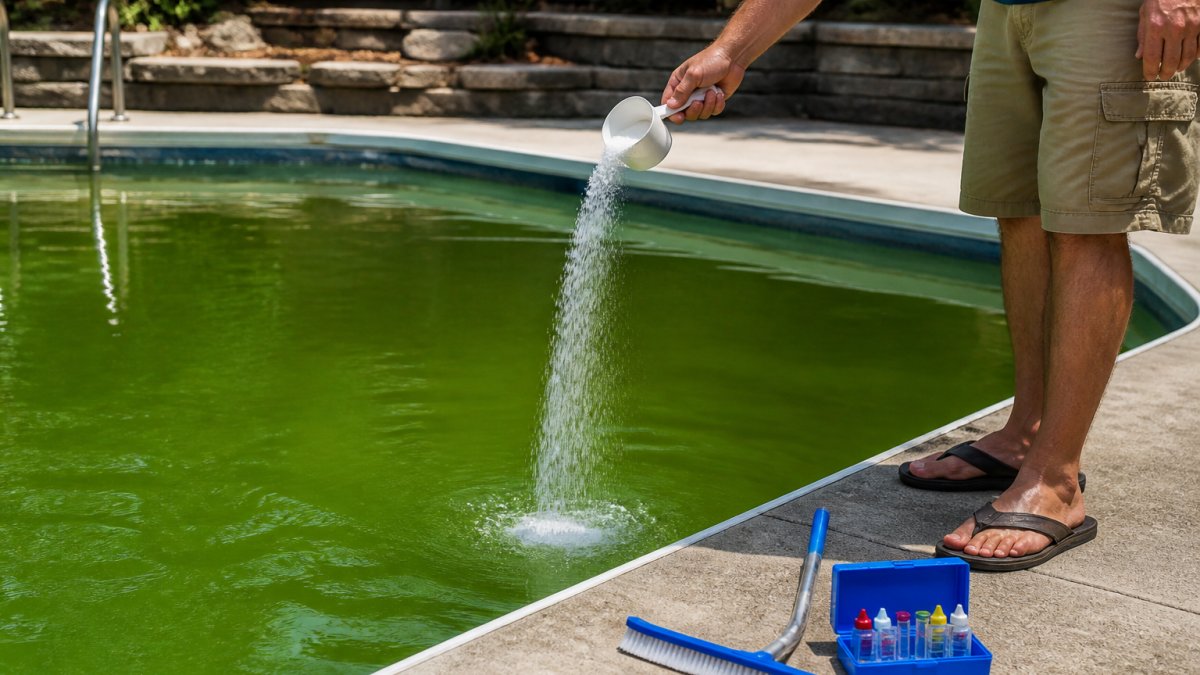
Shocking a pool with algae means raising the free chlorine level high enough to oxidize the algae and the organic matter feeding it, then holding that level until the water clears. The process is straightforward, but the order of steps matters more than the product label suggests, and the dose matters more than the order.
A Test-Based Algae Recovery Protocol
Most guides stop at 'dose and wait.' A bloom that keeps returning needs a protocol you can measure against, not a single application. Here is the sequence we walk customers through:
- Test the full panel first. Measure pH, total alkalinity, cyanuric acid (stabilizer), calcium hardness, and free chlorine. Write the numbers down, you will compare against them later. Algae treatments underperform in water that is out of range, and high stabilizer or high calcium changes which product you should use.
- Adjust pH to roughly 7.2 to 7.6. Chlorine loses killing power quickly outside this band. If pH is above 7.8, lower it before you shock; if below 7.0, raise it. Alkalinity should sit in the 80-120 ppm range for most pools.
- Brush every surface before dosing. Algae forms a protective layer; brushing breaks it open so the shock can reach it. Pay attention to walls, corners, steps, ladders, and the waterline tile, the places circulation misses.
- Remove debris. Leaves and organic load consume chlorine before it reaches the algae. Skim, vacuum, and empty the skimmer baskets.
- Calculate a target treatment level, not a maintenance dose. For an active green bloom, the goal is to raise free chlorine to a shock level appropriate to your stabilizer reading, commonly around 10 ppm free chlorine for a pool with 30-50 ppm cyanuric acid, and higher if stabilizer is higher. Use the label's algae treatment rate, not the routine maintenance rate, and dose according to your water volume (length × width × average depth × 7.5 for a rectangular pool in feet gives gallons; multiply by 3.8 for litres).
- Run the pump continuously and keep the filter clean through the treatment. Backwash or clean the filter when pressure rises 8-10 psi above the clean baseline.
- Retest and maintain the level. This is the step most owners skip. Check free chlorine every few hours during the first day and re-dose to hold the target until the water clears and chlorine holds overnight. A single dose that drops back to zero by evening did not finish the job.
- Retest the full panel after clearing. Confirm pH, alkalinity, and stabilizer are still in range, then return to routine maintenance.
Watch out: skipping the brushing step is the most common reason a shock treatment appears to do nothing. Algae on walls and in corners survives a dose that would clear free-floating cells. The second most common is stopping after one dose when the overnight chlorine test still shows a drop.
The Best Pool Shock for Green Algae
A fast-acting option is PoolBoss Insta-Boost Shock (6 kg), a treatment made to restore clarity and sanitation when a pool needs a reset.

Green algae is the most common and most treatable type. It responds well to a properly dosed shock, provided you brush and filter as described above.
The Insta-Boost formula suits weekly maintenance as well as recovery after heavy use, rainstorms, or heat waves.
How Long Does Pool Shock Take to Kill Algae?
The reliable test is not the clock but the overnight chlorine reading.
If free chlorine holds overnight after a shock dose, the algae is dead and you are clearing dead matter and debris. If it drops significantly overnight, live algae is still consuming chlorine and the pool needs another dose. That single test tells you more than any timeline. Most pool owners who think shock "didn't work" simply stopped dosing too early.
Why Is Pool Shock Not Killing Algae?
The most overlooked culprit is stabilizer. In pools that use stabilized chlorine products all season, cyanuric acid builds up and reduces chlorine's effectiveness. No amount of shock fixes that until you dilute the water through partial draining.
When shock alone stalls out, an algaecide is the logical next step. Use it after the initial shock and brushing, following the label rates for your water volume.
Choosing Shock Based on Pool Chemistry and Surface
Surface type and existing chemistry narrow the field faster than any marketing claim.
For vinyl liner pools, CAPO Vinyl-Shock (6 kg) at $89.99 is chlorine-free, fast-dissolving, and multi-action, acting as a shock, buffer, clarifier, and stain and scale preventor in one.

PoolBoss Concentrate Granular (6 kg) at $84.99 is a fast-dissolving concentrated sanitizer that helps control bacteria and algae as part of routine maintenance.
Picking the Right Shock at Poolside Supply
Choosing the right shock comes down to three questions: what surface do you have, what is your stabilizer level, and are you treating an active bloom or maintaining clear water. Answer those and the product choice becomes obvious.
At Poolside Supply, you can find pool chemicals and match the treatment to your test results. We serve pool owners in Burlington, Hamilton, and Oakville. Our Price Match Guarantee and Satisfaction Guarantee back your purchase.
Algae is a symptom, not the problem. Fix the chemistry, brush the surfaces, dose correctly, and the water clears.
Frequently Asked Questions
Should I shock my pool if it has algae?
Yes. Shocking is the standard first step for an algae bloom because it raises the free chlorine level high enough to kill algae cells and the bacteria feeding on them. Brush the walls and floor first to break the algae's protective layer, then shock at dusk so sunlight does not burn off the chlorine before it works. For a light green tint, one treatment often clears it; a heavy bloom may need a second dose 24 hours later.
What kills algae the fastest in a pool?
A fast-acting granular shock that dissolves quickly and raises free chlorine fast is the quickest route. PoolBoss Insta-Boost Shock 6 kg is built for exactly that reset, restoring clarity after heavy use, rain or cloudy water. Pair it with brushing and a filter run of at least 24 hours. Liquid chlorine works fast too, but granular is easier to dose and store for most residential pools.
Why is shock not killing algae in my pool?
The most common causes are too low a dose for the pool's volume, high cyanuric acid locking up the chlorine, or algae hiding under a layer of biofilm on the walls. Test free chlorine, pH and stabilizer before dosing again. If pH is above 7.8, lower it first; chlorine is far less effective at high pH. Brushing before and after shocking exposes algae the chemical cannot reach on its own.
Will shock get rid of yellow algae?
Mustard algae is tougher than green algae and often survives a single shock. It hides in shaded corners, behind ladders and under steps, so brush those areas hard before treating. Use a full dose of a fast-acting shock, then clean every item that touched the water, including floats, nets and swimsuits. Repeat the treatment if yellow patches return within a few days.
Can pool shock kill black algae?
Black algae is the hardest type and rarely clears from shock alone. Its waxy outer layer protects it, so you need to brush the spots aggressively with a stiff brush, ideally a stainless one on plaster, to break that layer before shocking. Expect several rounds of brushing and shocking over a week or more. Vinyl and fibreglass pools need a softer brush to avoid damage.
A green pool is frustrating, but it is almost always solvable with the right shock and a disciplined protocol. Poolside Supply carries the shock, algaecide, and sanitizer to match your pool's surface and chemistry, backed by expert advice from a team that knows these products. Get started with Poolside Supply and turn your green pool back into swim-ready water.
