

Last Updated: November 8, 2026
Quick Summary
Safe pool opening kits are worth it in 2026 when every bottle has a clear job and the dosage instructions match your water volume. A complete kit includes an oxidizer or shock, a stain and scale preventative, an algaecide and a printed instruction guide with dosing by pool size. Kits without a stated volume limit force you to guess the dose, which makes over-dosing a real risk.
- The CAPO Opening & Closing Pool Chemical Kit costs $64.99 and treats pools up to 100,000 litres.
- The PoolBoss Pool Open and Close Kit also costs $64.99 but states no volume limit on its listing.
- Stabilizer is often not included in opening kits, so it may need to be purchased separately.
- Run the pump continuously for 48 to 72 hours after opening before judging water clarity.
- Adding algaecide and shock at the same moment can neutralize both, so space them per the kit guide.
Table of Contents
- What a Safe Pool Opening Kit Actually Includes
- Quick Comparison: Pool Opening Kits at a Glance
- Pool Opening Chemicals You Need for Spring Startup
- Choosing a Pool Opening Kit for Above-Ground Pools
- Choosing a Pool Opening Kit for Saltwater Pools
- How to Open a Pool in Spring: Step by Step
- Safe Handling, Storage and Disposal of Opening Chemicals
- Ordering Your Opening Kit from Poolside Supply
- Frequently Asked Questions
What a Safe Pool Opening Kit Actually Includes
Safe pool opening kits are bundled sets of seasonal chemicals, plus an instruction guide, designed to bring a closed pool back to swimmable condition without guesswork.
A complete pool opening kit for spring startup typically contains:
- An oxidizer or shock to burn off winter contaminants and clear the water
- A stain and scale preventative to protect surfaces as metals reactivate
- An algaecide to knock back algae before it blooms
What separates a safe kit from a cheap one is transparency. You should be able to read the label and know exactly how many litres each bottle treats.
Watch out: kits sold without a stated volume limit force you to guess the dose, which makes over-dosing a real risk.
Quick Comparison: Pool Opening Kits at a Glance
Several kits are available, and two of them cost $64.99. The right pick depends on whether you want a single kit for both seasons or separate products for opening and closing.
| Kit | Price | Pool Size | What's Inside | Best For |
|---|---|---|---|---|
| CAPO Opening & Closing Pool Chemical Kit | $64.99 | Up to 100,000 litres | 1kg oxidizer, 1L stain & scale, 1L algaecide 40%, guide | Larger pools, one kit for spring and fall |
| PoolBoss Pool Open and Close Kit | $64.99 | Not stated on listing | Seasonal open and close treatments | All-in-one seasonal maintenance |
| CAPO Winterizing Kit | $74.99 | Up to 40,000 litres | 500g Oxy-Out, 500mL Meta-Sol, 500mL Formula 500, guide | Fall closing only |
Price
To see the full breakdown of the CAPO kit before you buy, view the CAPO Opening & Closing Pool Chemical Kit. The PoolBoss Pool Open & Close Kit covers opening and closing in one box.


The CAPO kit is one option for many pools, given its 100,000-litre coverage and fully stated ingredient list.
Pool Opening Chemicals You Need for Spring Startup
Spring startup chemicals do four jobs: oxidize, prevent staining, stop algae, and protect chlorine from sunlight. A kit covers the first three. The fourth, stabilizer, is often not included in opening kits, so it may need to be purchased separately.
- Oxidizer or shock: burns off bacteria, algae and organic debris left from winter
- Stain and scale preventative: keeps metals and minerals from settling on surfaces
- Algaecide: stops spores from blooming as water warms
If your kit does not include stabilizer, add it separately. The PoolBoss Stabilizer 900g is a 100% cyanuric acid formula that prevents chlorine loss from sunlight and extends how long your sanitizer lasts.

For heavier spring cleanup, a standalone shock is available as an additional product. PoolBoss Pool Shock 6kg is an unstabilized chlorinating granule that clears bacteria, algae and organic contaminants fast.
Choosing a Pool Opening Kit for Above-Ground Pools
Above-ground pools need the same chemistry as inground pools, but volume, surface and winter condition matter when you choose a kit. Check your actual water volume before dosing from any kit's label.
Start with volume, then match the kit
Measure length, width and average depth, then calculate volume in litres. A kit rated well above your actual volume is fine because you will use a fraction of each bottle, but a kit rated below it means you will run short mid-opening. For above-ground pools up to 40,000 litres, the CAPO Winterizing Kit at $74.99 handles the fall side with 500g Oxy-Out, 500mL Meta-Sol and 500mL Formula 500.
Match the kit to your surface
Check your pool's surface type before choosing a kit, and follow the product label's guidance for your liner or finish.
Match the kit to winter condition
Water condition at opening can vary, so check your pool's state before choosing how much product to use.
Compare kits by what is actually stated
- Stated volume coverage in litres. A kit without a stated limit forces you to guess the dose, and over-dosing is the most common opening mistake we see.
- Ingredient disclosure. You should be able to read the label and know the active ingredient and concentration for each bottle.
- Included protective guidance. A kit that tells you what to wear and what not to mix is safer than one that assumes you know.
Above-ground specifics that kits often miss
Run the pump continuously for 48 to 72 hours after opening before judging clarity, and clean or backwash the filter as the kit guide directs. For cloudy water after opening, CAPO Quick Clear 1L is a concentrated clarifier that helps the filter pull suspended particles without shifting pH.
Dose by your actual pool volume, not by the kit's maximum.
Choosing a Pool Opening Kit for Saltwater Pools
Saltwater pools need everything a chlorine pool needs at opening, plus attention to the salt cell.
- Test salt level and add salt before relying on the generator
- Clean the salt cell if it shows scale from winter
- Balance pH and alkalinity so the cell works efficiently
For the cell itself, the Capo Salt Cell Cleaner is the product to have on hand during opening.
Algae prevention is important in all pools, including saltwater pools. PoolBoss X-tra Strength Algaecide 1L controls green, black and mustard algae and is safe for all pool surfaces.
How to Open a Pool in Spring: Step by Step
Opening a pool can be done over a weekend if you follow a clear order. The sequence below works for most residential pools and keeps chemical additions from canceling each other out.
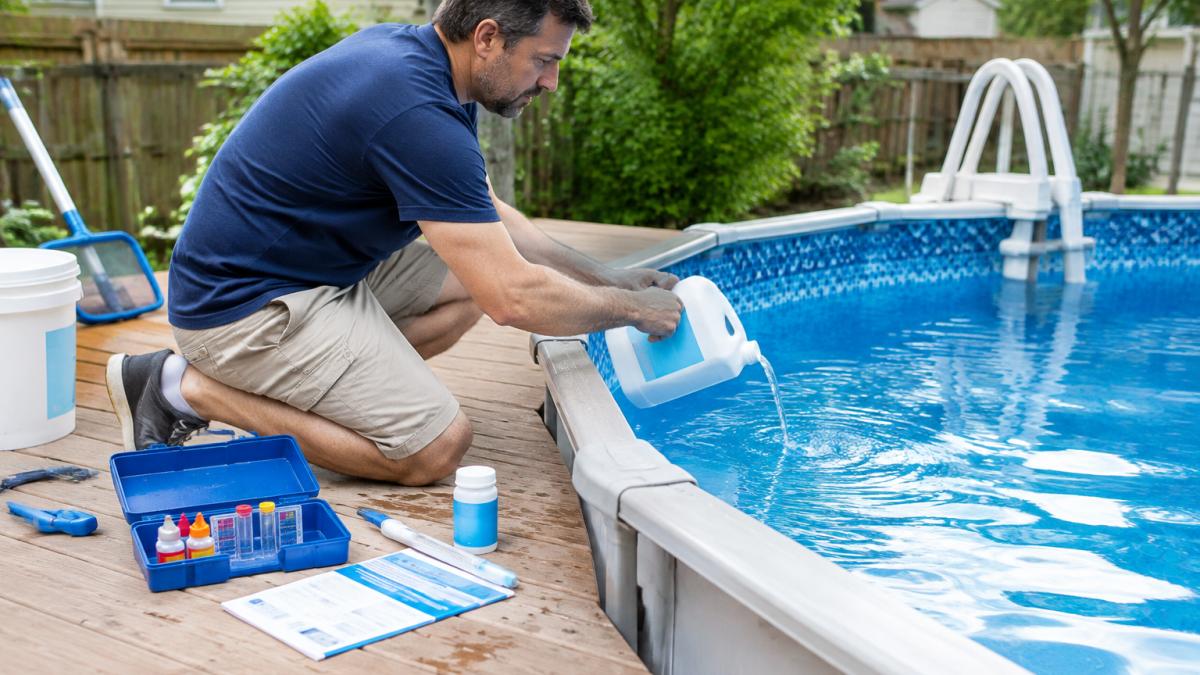
- Remove and clean the winter cover. Pump off standing water first, then scrub and dry the cover before storage.
- Clear debris from the pool. Skim, vacuum and empty the skimmer baskets. Use skimmer socks to catch fine particles.
- Fill to the correct water level and check for leaks around fittings.
- Start the pump and run continuous circulation for 48 to 72 hours before judging water clarity.
- Test the water with a full test kit: pH, alkalinity, calcium hardness, stabilizer and sanitizer.
- Balance the water before adding anything else. Adjust alkalinity first, then pH.
- Add your opening kit chemicals in the order the guide states, pre-dissolving granules.
- Shock the pool and run the filter until the water clears.
- Retest after 48 hours and adjust before swimming.
Watch out: adding algaecide and shock at the same moment can neutralize both. Space them according to the kit guide.
For cloudy water after opening, CAPO Quick Clear 1L is a concentrated clarifier that helps the filter pull suspended particles without shifting pH.
Safe Handling, Storage and Disposal of Opening Chemicals
Chemical safety matters when opening a pool. Pool chemicals are oxidizers, acids and bases that can react with each other, with water and with heat. Handle them carefully and follow each product's label.
Read the label before anything else
Read the label on each container before you open the lid. Read it before you open the lid, and follow it over any general advice, including this article. Labels differ between products that look identical: a granular shock and a granular pH increaser can both be white powder in a white pail, but one is an oxidizer and the other is a base, and mixing them is dangerous.
The incompatibility rules that prevent most accidents
- Never mix chemicals together outside the pool, even in small amounts, and never in a bucket. Oxidizers and acids react violently; oxidizers and bases can generate heat and gas.
- Add chemicals to water, never water to chemicals. This matters most with dry acid and with granular shock. Pouring water onto a concentrated chemical can cause a sudden exothermic reaction and spatter.
- Keep oxidizers away from acids, bases, and anything organic such as fertilizer, fuel, paint, or sawdust. Keep shock away from gasoline and other flammable materials.
Personal protective equipment
At minimum, wear chemical-resistant gloves and splash goggles when handling shock, algaecide, pH adjusters and stabilizer. Add a long-sleeved shirt and closed shoes when pouring granular product, because static and wind can carry dust. Keep a bucket of clean water nearby for immediate rinsing, and know where your eyes can be flushed for 15 minutes if needed. Do not eat, drink or smoke while handling chemicals, and wash hands after every addition.
Storage that survives a Canadian winter and summer
Store chemicals in a cool, dry, well-ventilated space, off the floor and away from direct sunlight, as the product label directs. Keep containers sealed, upright and labelled, and never transfer product into food or drink containers, which is how accidental poisonings happen. Store oxidizers separately from acids and from anything flammable, and keep the storage area locked or out of reach of children and pets.
If a container is bulging, do not open it; contact your municipality or the manufacturer for guidance.
Disposal and leftovers
Check with your municipality about how to dispose of leftover chemicals and empty containers. Never pour them down a drain, into a storm sewer, or into the trash, and never burn packaging.
For pH correction, PoolBoss pH Down 3kg uses sodium bisulphate to lower pH.
For deeper guidance on handling strong acids around a pool, read our walkthrough on how to add muriatic acid to a pool safely before you open this season.
Ordering Your Opening Kit from Poolside Supply
Choosing the right kit comes down to three numbers: your pool volume in litres, your pool type, and whether you want one kit for both seasons or separate opening and closing products. Get those right and the chemistry follows.
We stock the kits and the supporting chemicals in one place, with a Price Match Guarantee and a Satisfaction Guarantee. Tell us your pool size and surface type, and we will help you choose a kit.
Ready to open clean and safe this season? Browse our opening and closing kits and get your water swim-ready.
Opening a pool safely is mostly about order and dosage, not expensive products.
Frequently Asked Questions
What should a safe pool opening kit include?
A complete kit covers oxidation, stain and scale control, and algae prevention. The CAPO Opening & Closing Pool Chemical Kit, for example, includes 1kg of oxidizer, 1L of stain and scale treatment, and 1L of algaecide 40%, plus an instruction guide, for pools up to 100,000 litres. You will still need to test and balance pH, alkalinity and stabilizer separately, so check whether your kit includes those or whether you buy them alongside.
Are pool opening kits safe to use?
They are safe when you follow the label and the included instruction guide. Keep granular shock and pH Down separate from each other and from liquids, add chemicals to water rather than water to chemicals, and never mix products in one container. Wear gloves and eye protection, work in a ventilated area, and store everything in a locked, dry spot away from heat. Read each product label before opening, because dosage and compatibility differ between formulas.
How do I choose a pool opening kit for my pool size?
Match the kit's stated volume coverage to your pool's actual water volume in litres, not its footprint. The CAPO Opening & Closing Pool Chemical Kit covers pools up to 100,000 litres, while the CAPO Winterizing Kit is built for pools up to 40,000 litres. If your pool sits near the top of a kit's range, buy the next size up or plan to top up individual chemicals, since under-dosing wastes the whole treatment.
How long should I wait to swim after adding pool opening chemicals?
Wait until chlorine drops back into the normal range and the water is clear, which usually means running the pump continuously for 48 to 72 hours after shocking. Test the water before anyone gets in. For saltwater pools, confirm the salt level and that the generator is producing chlorine before you remove the safety cover for the season. If the water is still cloudy or the chlorine reading is high, keep swimmers out and keep circulating.
How do I safely store leftover pool chemicals?
Keep leftovers in their original labelled containers with lids sealed tight, in a cool, dry, locked space away from sunlight and moisture. Store oxidizers apart from acids such as pH Down, and never stack liquid bottles above dry chemicals in case of leaks. Keep the instruction guide with the kit so next season's dosage is on hand. Dispose of expired or unneeded chemicals through your municipal household hazardous waste program rather than pouring them down drains.
