

Last Updated: November 5, 2026
Quick Summary
To add muriatic acid to a pool safely, put on goggles and chemical-resistant gloves, test pH and total alkalinity first, and dilute the acid by adding it to a plastic bucket of pool water, never water to acid. Pour the mix slowly into the deep end near a return jet with the pump running, and never pour it into the skimmer.
- Muriatic acid is a diluted form of hydrochloric acid that lowers pH and total alkalinity.
- For a 20,000 L pool, start with about 500 mL of full-strength acid for a 0.2 pH drop.
- Wait at least 30 minutes after adding acid before anyone swims, and only after retesting.
- Never store muriatic acid next to chlorine, because mixing them releases dangerous gas.
- For skin contact, rinse with cool running water for at least 15 minutes.
Table of Contents
- What You'll Need Before You Add Muriatic Acid
- Muriatic Acid Pool Dosage Chart: Calculating the Right Amount
- Where to Add Muriatic Acid to a Pool
- Muriatic Acid Pool Safety Precautions
- How Long to Wait to Swim After Adding Muriatic Acid
- pH vs. Total Alkalinity: Which Problem Are You Actually Fixing?
- Common Mistakes to Avoid When Adding Muriatic Acid
- Choosing the Right Acid Product for Your Pool
- Frequently Asked Questions
What You'll Need Before You Add Muriatic Acid
Adding muriatic acid to a pool safely starts with the right gear and a fresh water test. Muriatic acid is a diluted form of hydrochloric acid that lowers pH and total alkalinity in pool water. Never open the bottle until you know your numbers and your safety gear is on.
Here is what to have ready before you start:
- Safety goggles that seal around the eyes
- Chemical-resistant gloves, not garden gloves
- Long sleeves and pants to protect skin
- A plastic bucket for diluting acid
- A clean plastic measuring cup used only for acid
- A test kit or test strips for pH and alkalinity
- The pool pump running
Skip any of these and you are taking an avoidable risk. Acid burns happen fast, and fumes build up quickly in still air.
Safety Gear and Test Kit Checklist
Test your water first, always. You need to know both pH and total alkalinity before you pour anything. A reading tells you whether you have a pH problem, an alkalinity problem, or both.
Use a SpaBoss Test Strips 50 pack for quick readings, or a liquid test kit for more precision. Dip, wait the stated time, and read the colors in good light.

Then run through this checklist:
- Goggles on and sealed
- Gloves on
- Long sleeves and closed shoes
- Bucket and measuring cup ready
- Pump running
- pH and alkalinity readings written down
- Acid stored upright, away from chlorine
A common mistake is testing right after adding chemicals. Wait for the water to circulate before you retest, or your numbers will mislead you.
Muriatic Acid Pool Dosage Chart: Calculating the Right Amount
There is no single dose that fits every pool. The right amount depends on your pool volume, your starting pH, your total alkalinity, and the strength of the acid you bought. A muriatic acid pool dosage chart is a starting point, not a guarantee.
Liquid muriatic acid sold for pools comes in different strengths, so always read the label on your bottle. Always read the label on your bottle, because the same volume of a half-strength product will lower pH roughly half as much as full strength.
Here is a practical reference for a typical pool using full-strength acid. Treat these as estimates and always start low:
| Pool Volume | pH Drop Goal | Starting Dose (full strength) |
|---|---|---|
| 10,000 L | 0.2 | About 250 mL |
| 20,000 L | 0.2 | About 500 mL |
| 40,000 L | 0.2 | About 1 L |
| 50,000 L | 0.2 | About 1.25 L |
To adjust for a different pH drop goal, scale the dose roughly in proportion. For example, if 20,000 L needs about 500 mL for a 0.2 drop, a 0.4 drop would call for roughly 1 L as a starting estimate.
Worked Examples Across Pool Volumes and Strengths
Example 1: Small above-ground pool, full strength. A 10,000 L pool reads pH 7.8 with normal total alkalinity. Using the chart, start with about 250 mL of full-strength acid, pour it near the return jet with the pump running, and retest after a few hours of circulation. If pH is still high, add another 125 to 250 mL rather than doubling the first dose.
Example 2: Mid-size pool, half strength. A 20,000 L pool reads pH 7.9.
Example 3: Large pool with high total alkalinity. A 40,000 L pool reads pH 8.0 and total alkalinity of 180 ppm. High total alkalinity soaks up acid, so the first dose may barely move pH.
Example 4: Cold water. A 50,000 L pool at 15°C reads pH 7.8. Because cold water can delay the pH response, check water chemistry again after circulation has had time to distribute the acid.
Pour less than you think you need. You can always add more, but you cannot take acid back out. Retest after a few hours of circulation and adjust again if needed.
Where to Add Muriatic Acid to a Pool
Pour muriatic acid into the deep end of the pool, near a return jet, with the pump running. Never pour it into the skimmer. Acid in the skimmer damages the pump, filter, and plumbing.
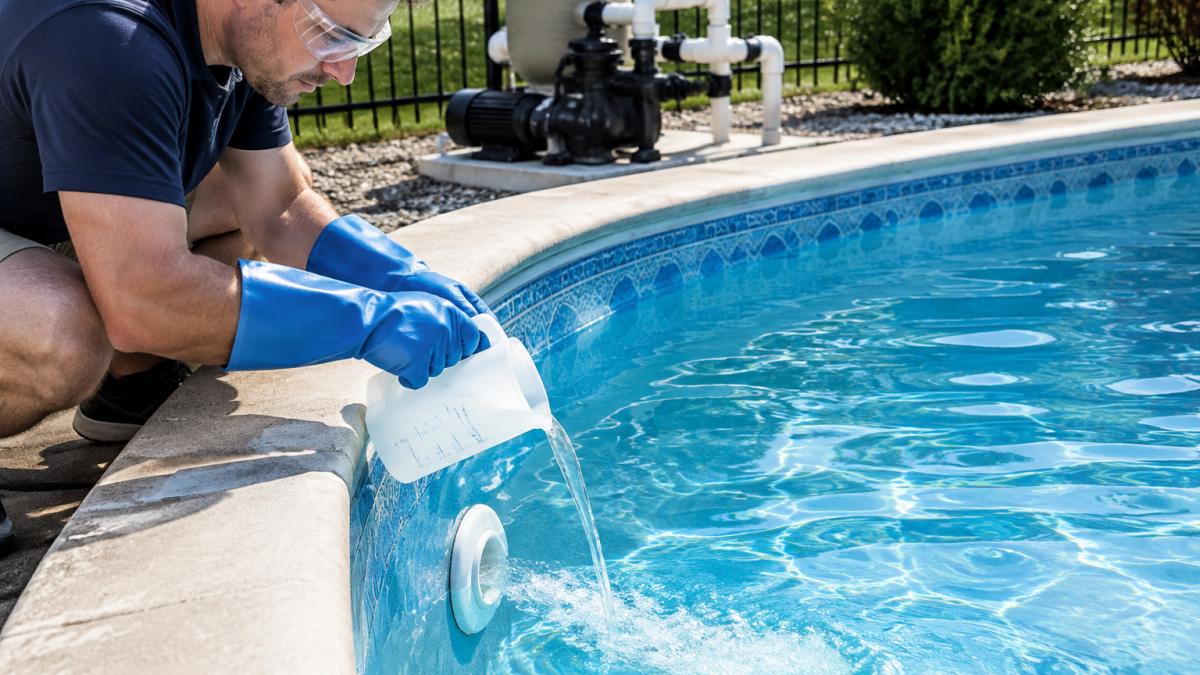
Follow this order:
- Fill a plastic bucket with pool water first
- Add the acid to the water, never water to acid
- Stir gently with a plastic tool
- Pour the mix slowly near the return jet
- Let the pump run to spread it
Pouring acid into a bucket of water is the safe direction. Adding water to concentrated acid can cause a violent reaction and splashing.
Walk around the pool as you pour so the acid spreads. Keep your face back and away from fumes. If the wind is blowing, work from the upwind side.
Muriatic Acid Pool Safety Precautions
Muriatic acid safety comes down to protecting your body, protecting your lungs, and never mixing chemicals. Acid fumes are harmful, and splashing is the most common cause of injury.
Keep these rules in mind every single time:
- Always add acid to water, never water to acid
- Work outdoors or in good ventilation only
- Keep your face turned away from the bottle opening
- Store acid upright, in a cool, dry spot
- Keep acid away from chlorine and other chemicals
Watch out: never store muriatic acid next to chlorine. If the two mix, they release dangerous gas. Store them apart, always. Keep acid in its original labeled container with the cap tight, and keep it out of reach of children and pets. Do not store acid in a metal shed or near metal equipment, because fumes can corrode metal over time.
Emergency Response and First Aid
Act fast if acid touches skin, eyes, or clothing. Seconds matter with any acid burn.
- Skin contact: brush off any dry chemical if present, then rinse with cool running water for at least 15 minutes. Remove any wet clothing while rinsing. Seek medical help if the skin is blistered, broken, or painful after rinsing.
- Eye contact: flush the eye with water for at least 15 minutes, holding the eyelid open, and get medical help right away (Wood preservation facilities, pentachlorophenol pressure: chapter E, table 5). Do not rub the eye.
- Fumes inhaled: move to fresh air immediately and rest. If breathing is difficult or symptoms persist, seek medical help.
- Swallowed: do not induce vomiting, rinse the mouth, and call for emergency help. Do not give anything to drink unless instructed by a medical professional.
Spill response. If acid spills, keep people and pets away, ventilate the area, and do not use a wet mop or paper towels that will spread the acid.
Accidental mixing. If acid is accidentally mixed with chlorine or another chemical and you see or smell gas, leave the area immediately, get to fresh air, and call for emergency help. Do not try to neutralize a mixed-chemical cloud yourself.
If you are unsure about any exposure, call your local poison control or emergency services. Do not wait to see if symptoms pass.
How Long to Wait to Swim After Adding Muriatic Acid
Wait at least 30 minutes after adding muriatic acid before anyone swims, and only once the water has circulated and you have retested. For larger doses or high alkalinity, wait longer, closer to an hour or more.
The safe rule is simple: retest first, swim second. Confirm pH is back in the ideal range and the acid has fully mixed. If the water still reads high, keep people out and let the pump keep running.
Never let anyone swim while you are actively pouring acid. Keep pets and kids away from the area until the dose is fully circulated and tested.
pH vs. Total Alkalinity: Which Problem Are You Actually Fixing?
High pH and high total alkalinity are two different problems, and they need different fixes. pH measures how acidic or basic the water is (Guidelines for Canadian Drinking Water Quality: Guideline Technical Document - pH). Total alkalinity measures the water's ability to resist pH changes.
Use this simple decision path:
- High pH, normal alkalinity: add acid to lower pH
- High pH, high alkalinity: add acid to lower both, then aerate to bring pH back up if needed
- Low alkalinity: raise alkalinity first with a stabilizer, then adjust pH
Getting the order wrong wastes chemicals and leaves your water unstable. If your alkalinity is low and you keep adding acid for pH, you will only make things worse. For low alkalinity, PoolBoss Alka-Plus 2kg raises total alkalinity and prevents pH bounce.

To learn the full correct sequence for adjusting your water, read our guide on how to balance pool water chemistry in the right order.
Common Mistakes to Avoid When Adding Muriatic Acid
The biggest mistakes with muriatic acid are easy to prevent once you know them. Most come from rushing or skipping a step.
Watch out for these:
- Pouring acid into the skimmer instead of the deep end
- Adding water to acid instead of acid to water
- Dosing without testing first
- Adding more acid before the last dose has circulated
- Storing acid beside chlorine
- Skipping goggles and gloves because the job seems quick
A common mistake is pouring acid and chlorine at the same time. Space them out and never mix them in the same bucket.
If you want a broader reference to avoid repeat problems, our water care guide covers the full routine for keeping water clean and safe all season.
Choosing the Right Acid Product for Your Pool
Dry acid and liquid muriatic acid both lower pH, and the right pick depends on how you like to handle chemicals.
For many pool owners, a dry acid product is the simpler, safer choice. It lowers pH without the strong fumes of liquid acid. If you want a ready-to-use option, our PoolBoss pH Down 3kg is a dry acid formula that lowers pH, improves sanitizer effectiveness, and enhances swimmer comfort.

Whichever you choose, match the dose to your pool volume and retest after each adjustment. The label tells you the strength, so always read it before you pour.
Frequently Asked Questions
How much muriatic acid should I add to my pool?
The right dose depends on your pool volume, starting pH, and the acid's concentration. Always check your product label for its specific strength and follow its dosing directions. Test the water first, use a dosage chart, pour slowly near the return jet with the pump running, and retest after a few hours before adding more. Adding too much at once is harder to correct than adding in stages.
Should I dilute muriatic acid before adding it to a pool?
Most manufacturers advise adding acid directly to the pool rather than pre-mixing it, because diluting acid in a bucket creates fumes and heat, and splashing risk goes up. If your label says to dilute, always add acid to water, never water to acid. Pour slowly near the return jet with the pump running so the acid disperses quickly. For pools with delicate surfaces, some owners prefer a diluted pour, but follow the product instructions first.
Can I add muriatic acid and chlorine to a pool at the same time?
No. Mixing muriatic acid and chlorine, whether in the pool or in a container, can release dangerous chlorine gas. Add them at least 30 minutes apart, and never pour them into the same spot. Add acid first, let the pump circulate the water, then add chlorine. Store the two products separately and never in the same sealed container. If you are shocking the pool, wait until the chlorine level drops before adjusting pH.
How long should I wait to swim after adding muriatic acid?
Wait at least 30 minutes after adding muriatic acid before swimming, and only if the pump has been running the whole time. Retest pH and chlorine before anyone gets in. If pH is still outside the 7.2 to 7.8 range, wait longer and adjust again. For pools with poor circulation or cool water, extend the wait to an hour. Always confirm the water looks clear and the chemicals have dispersed before swimmers return.
Adding acid is one of those jobs that feels intimidating until you have done it once with the right gear and a clear plan. If you want the right products and someone to walk you through it, Poolside Supply carries pH reducers, alkalinity stabilizers, and test strips, backed by a Price Match Guarantee and a Satisfaction Guarantee. Our team helps new pool owners balance water with confidence. Get started with Poolside Supply and keep your water clean, safe, and ready to swim.
