

Last Updated: November 10, 2026
Quick Summary
To clear cloudy pool water fast, test the water first, then fix total alkalinity, pH and free chlorine in that order before touching the filter. If chemistry is in range and the water is still milky, clean the filter or add a clarifier, and shock when free chlorine is low or combined chlorine is high.
- Cloudy water comes from fine debris, poor circulation, out-of-range chemistry or starting algae.
- Adjust total alkalinity first, pH second, and free chlorine third, dosing by pool volume.
- Backwash sand and DE filters when pressure rises 8 to 10 psi above baseline.
- Use a clarifier for mild haze and a flocculant for thick, milky water.
- Never stack clarifier, flocculant and shock in the same day, and run the pump continuously until clear.
Table of Contents
- Start With the Cloudy Pool Water Causes Behind the Haze
- Test the Water Before You Add a Single Chemical
- Fix Pool Chemistry: pH, Alkalinity, and Free Chlorine
- Pool Water Clarifier vs Flocculant: Which One Fits Your Cloudiness
- Pool Filter Troubleshooting and Circulation Fixes
- How Long Does It Take to Clear a Cloudy Pool?
- Frequently Asked Questions
Start With the Cloudy Pool Water Causes Behind the Haze
Cloudy pool water is a loss of clarity caused by particles too small for the filter to catch.
A common pattern is a panicked shock dose, then another, then a clarifier, then a flocculant, with the pool still milky.
Below, we'll show you how to clear cloudy pool water fast by matching the symptom to the cause first.
So what actually turns a pool cloudy? Four things, almost always.
- Fine debris and suspended particles too small for the filter to trap
- Poor circulation, so dirty water never reaches the filter at all
- Chemistry out of range, usually high pH or low free chlorine
Match the Symptom to the Cause
Use the water's appearance and your test results to pick the right fix. The table below is the fastest way to stop guessing.
| What You See | Likely Cause | First Move |
|---|---|---|
| Milky white, chlorine normal | Fine suspended particles | Clarifier, then filter |
| Hazy with high pH | pH above ideal range | Lower pH, then retest |
| Dull and slightly green | Algae bloom starting | Shock plus algaecide |
| Cloudy after heavy rain | Debris and dilution | Skim, vacuum, shock |
| Cloudy after opening | Settled debris stirred up | Filter 24 hours, then assess |
Cloudiness has several possible causes, and each calls for a different fix. A clarifier will not fix high pH, and shock will not remove dead particles already suspended.
A Diagnostic Decision Tree Based on Test Results
Before you add anything, run a full test and read the numbers in this order.
- Free chlorine below the ideal range for your sanitizer. Shock to raise free chlorine, hold it, and retest after circulation. If combined chlorine is high, shock is still the right move, it burns off the chloramines causing the smell and haze.
- Free chlorine in range but pH above the ideal range. High pH reduces chlorine efficiency and lets minerals cloud the water. Lower pH first, retest, then reassess clarity before adding clarifier.
- Free chlorine and pH both in range, total alkalinity low or swinging. pH will keep drifting and cloudiness will return. Raise alkalinity into range, then rebalance pH.
- Chemistry all in range, water still milky white. Check filter pressure against baseline. If high, clean the filter first. If normal and the haze persists, a clarifier is the right next step.
- Chemistry in range, water dull or slightly green, and chlorine demand keeps rising. Algae is starting. Shock, brush, and run the filter continuously. Move to a flocculant only after the algae is dead.
- Cloudy within a day of heavy rain or heavy bather load. Skim, vacuum, shock, and filter. Do not reach for flocculant until the filter has had 24 hours to work.
Watch out: do not stack treatments. Adding clarifier, then flocculant, then shock within the same day can bind chemicals, overload the filter, and make the haze worse. Fix one branch, retest, then move to the next.
Test the Water Before You Add a Single Chemical
Testing first separates a fast fix from a wasted week. A basic test kit gives you free chlorine, pH, and total alkalinity in minutes, and those three numbers decide everything that follows.
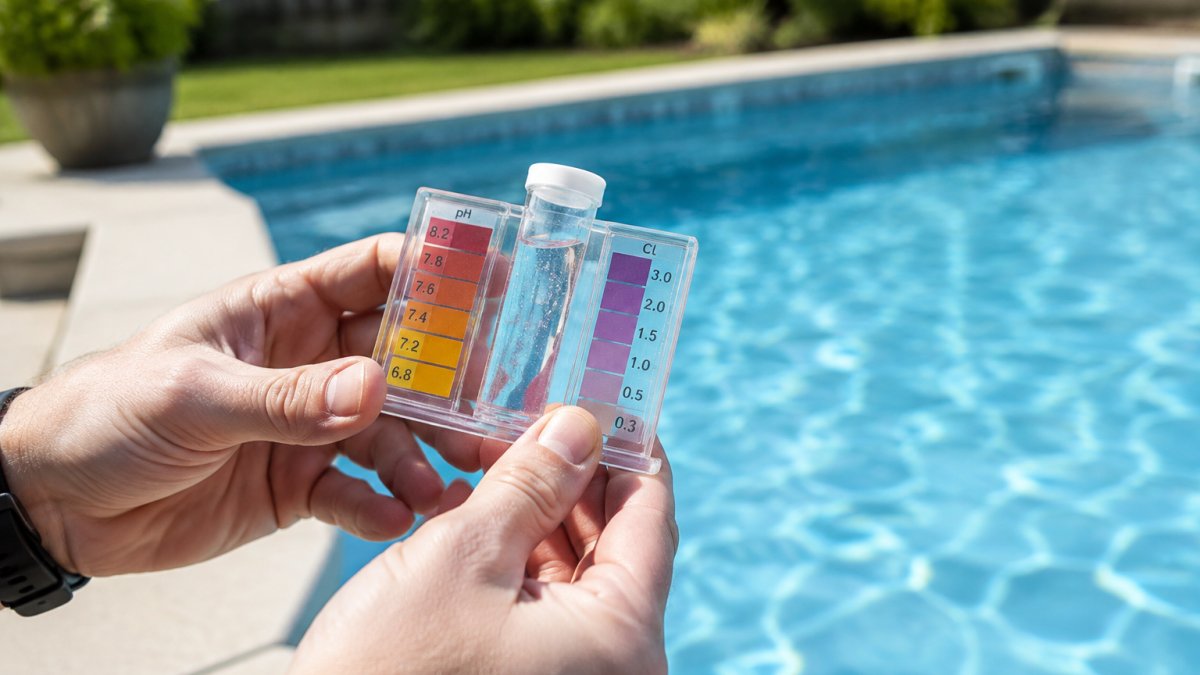
Record your numbers before you touch a chemical. Then check them against the ranges below.
- Free chlorine: keep it in the ideal range for your sanitizer
- pH: slightly on the lower side of neutral works best for chlorine efficiency
- Total alkalinity: buffers pH so it does not swing
- Calcium hardness: too low and water pulls minerals from surfaces
The Health Canada guidance on recreational water quality is a useful reference for what safe pool water looks like. For a full rundown of the chemicals involved, see our Water Balance range.
Fix Pool Chemistry: pH, Alkalinity, and Free Chlorine
Chemistry comes before filtration, because chlorine cannot do its job in water with the wrong pH. Correct the balance, and every step after it works faster.
Work in this order:
- Total alkalinity first. Adjust it into range so pH stops drifting.
- pH second. Use pH down, liquid pool acid or dry acid, following the label dose for your pool volume.
- Free chlorine third. Raise it to the ideal range, then hold it there.
Dose by pool volume, never by eye. A 20,000-litre pool and a 45,000-litre pool need very different amounts of the same product. Check the label, measure in litres, and retest after the chemical has circulated for a few hours.
Shock the Pool When Chlorine Is Low or Combined Chlorine Is High
Shock treatment is the right move when free chlorine has dropped too low or combined chlorine is high.
For this, we recommend PoolBoss Pool Shock 6kg. It is an unstabilized chlorinating granule formula that acts quickly against bacteria, algae, and organic contaminants.

Watch out: never mix shock with other chemicals, and never add it to a pool someone is swimming in.
Pool Water Clarifier vs Flocculant: Which One Fits Your Cloudiness
A clarifier suits mild haze and fine suspended particles.
A clarifier works with your filter and clears the water over a day or two.
For everyday haze, CAPO Quick Clear 1L is a good option.

Best for: mild to moderate cloudiness with balanced chemistry. Skip if: the water is thick and milky and the filter has been running for days with no change.
Pool Filter Troubleshooting and Circulation Fixes
If chemistry is right and the water is still cloudy, the filter is the bottleneck. A filter that is clogged, undersized, or running too few hours cannot clear particles no matter what you add.
Record the pressure right after a fresh cleaning or backwash, that number is your baseline. A reading 8 to 10 psi above baseline means the media is loaded and flow has dropped.
Sand Filters
Backwash when pressure rises 8 to 10 psi above baseline, then rinse for 15 to 30 seconds before returning to filter. If backwashing no longer drops the pressure, the sand may be channeled or gummed up with oils and scale. Check that the laterals are intact, broken laterals let sand into the pool and cause persistent haze.
Cartridge Filters
Remove the cartridge and hose it down from the top down, pleat by pleat. A cartridge that stays gray after cleaning, or that has crushed pleats or a torn end cap, needs replacing. Never run a cartridge filter without the cartridge in place, debris will bypass and return to the pool.
DE Filters
Backwash when pressure rises 8 to 10 psi, then recharge with the correct amount of DE for your filter model, usually stated on the tank label. If the pressure climbs quickly after a recharge, the grids may be coated with oils or scale and need a full teardown and soak. Torn grids let DE into the pool and cause a white haze that will not clear with clarifier.
Circulation Checks
Run the pump long enough each day for the whole volume to turn over at least once, ideally twice during a cleanup.
Watch out: never mix filter media types or substitute one for another, using sand in a cartridge housing or DE in a sand filter will damage the filter and dump media into the pool.
If your cartridge filter is the weak point, a Hayward SwimClear Multi-Element Cartridge Filter is worth a look. Where poor circulation traces to the pump itself, view a Hayward Tristar Pump to restore proper flow.

How Long Does It Take to Clear a Cloudy Pool?
The timeline depends on how far off your chemistry was, how well the filter is working, and how long you run the pump.
Keep the pump running continuously until the water clears, then retest.
Cloudy water is almost always a diagnosis problem, not a product problem. Test first, balance the chemistry, then choose between a clarifier and a flocculant based on how bad the haze really is.
Frequently Asked Questions
Can I swim in a cloudy pool?
Stay out until the water clears. Cloudy water means the sanitizer may not be keeping up with bacteria and organic matter, and you cannot see the bottom, which is a safety risk. If free chlorine is below the ideal range of 1 to 3 ppm or combined chlorine is above 0.5 ppm, keep everyone out. Wait until chlorine holds steady, pH sits between 7.2 and 7.8, and you can see the drain clearly before swimming again.
Will shock clear a cloudy pool on its own?
Sometimes, but only when low chlorine or algae is the actual cause. Use an unstabilized shock such as PoolBoss Pool Shock 6kg ($89.99) and run the pump while retesting afterward. If the water is still cloudy after shocking, the problem is usually filtration or fine suspended particles, not sanitizer. In that case, a clarifier like CAPO Quick Clear 1L ($19.99) helps the filter capture what shock loosened.
Should I use a pool water clarifier or flocculant for cloudy pool water?
Use a clarifier for mild haze caused by fine debris, and a flocculant only for heavy cloudiness where particles will not settle. A clarifier such as CAPO Quick Clear 1L ($19.99) helps the filter remove suspended particles without changing pH. Flocculant drops everything to the pool floor so you can vacuum it out, but it takes longer and requires careful vacuuming to waste. Try the clarifier first.
Why is my pool still cloudy after shocking it?
Shock kills contaminants but leaves dead organic matter and fine debris floating, so the water stays hazy until the filter removes it. Check filter pressure, backwash or clean the cartridge, brush the walls and floor, and run the pump continuously for 24 to 48 hours. If cloudiness persists, test total alkalinity and calcium hardness, since high levels cause scaling haze. A clarifier or a filter check usually solves what shock alone cannot.
